Sunday, October 19, 2014

Another Random George Carlin Moment

When it came to explaining things, we used to break it down for our listener, as in, “There’s a lot going on in this article/story/episode/blogpost rant. Let’s break it down.” Now we unpack, as in, “This is a really loaded article/story/episode/ blogpost rant with much to unpack, so let’s begin.”

Whether this change from breaking things down to unpacking is good or bad, or what American English language maven George Carlin would have made of this, is speculation. Speculate away. It’s a beautiful Sunday. I’m taking a walk.
Sic transit gloria October.


“Regret” by New Order: One of the Most Perfect Pop Songs Ever Made

It’s a bold statement but it’s conviction, not clickbait, that inspires the title. The more I listen to this, the more I like it.

Curiously, I didn’t like the song much at all when I first heard it. As it was released in April 1993  I would have had to have heard this first in California, and I probably wondered why 80s pop was playing on the X-alt station out of Tijuana while the rest of the world was all about grunge and alt-rock. I’m fairly certain I had to have heard “Regret” played on the Armed Forces Radio in Japan while I was there from 1994 through 1997. 

If I’m sounding ambiguous, it’s because I can’t for the life of me remember any particular instance where I’ve heard it. The song has always been “just there.” It wasn’t until decades later in Colorado, when I was listening to a disc from The Brit Box: UK Indie, Shoegaze, and Britpop Gems (now out of print) from the library that I came across this again—and flippin’ loved it.

Took me long enough, eh?


I can’t get over the anachronistic sound. This had to have confused, if not angered a lot of people in 1993, who, like myself, were ecstatically happy to have the brightly colored, slickly packaged, synth-pop 1980s behind them. Unlike a lot of those empty confections, though, this song endures. It’s no accident that “Regret’s” single guitar riff and Peter Hook’s driving, proactive bass make it happen, with the synthesizer chords merely providing atmospheric backup, like the very moods of the sky under which everyone else is playing. Add Bernard Sumner’s plaintive, very 1980s voice (as opposed to that 1990s slur/growl) singing lyrics in which the character dreams of a place to call his own—that universal ache to live like “real people,” whoever they are—and you’ve got a song for the ages. 

Especially for mid- to late-October Sundays when the sky is bright, the sun is warm, but there’s a shivery chill to the wind, and we’ll have to clean up these leaves eventually. But only when the wind dies down, the sky closes over gray, and the gold of these leaves fades to dull , crumbling brown. 

Meanwhile, let’s enjoy the color and the sunshine and the mood before it all bleeds away.

Thursday, October 16, 2014

Fall Color Is Still On For Colorado Springs

A few days back I lamented the early stripping of the trees due to a strong storm that was coming through the Front Range. While the storm made the usual mess of limbs and leaves, it wasn’t so severe that it closed October down early on us.

My favorite aspens in my neighbor’s back yard are a little thinned out, but still quite beautiful:


The above photo is from this afternoon. The following are from a walk I took through the neighborhood greenbelts the day after Sunday’s storm. We’re smack in the middle of that most wonderful month on the North American calendar, and looking very much the part.


Halloween and my birthday aside, what I really love about this month is the light shines in a way you never see at any other time of the year. You’d think there would be one other time as the sun takes the same position in the sky on its way back north after the solstice, but no. 


Below is the view of Pikes Peak from the eastern end of Frontier Park behind my house. The storm left quite a bit of snow on the mountains. 


This may be my last October in the state of Colorado so this is, as they say, bittersweet. Once my son graduates, we hope to sell the house and move to upstate South Carolina. Wherever you are, here’s hoping it’s at least half as pretty.

Tuesday, October 14, 2014

Free, Public Domain Ghost Stories by a Master Who All But Invented the Form

M.R. James may not have invented the form, but he refined it to such a degree we almost can’t imagine it any other way. It’s rarely been done as well since the early 20th century when James was on the scene with such books as Ghost Stories of an Antiquary, A Thin Ghost and Others, and A Warning to the Curious.

Thanks to the Internet and the work of the people behind www.thin-ghost.org, you can read these for yourself, and decide if no less a contemporary than H.P. Lovecraft was wrong when he wrote, in his essay “Supernatural Horror in Literature”:

Montague Rhodes James has an intelligent and scientific knowledge of human nerves and feelings; and knows just how to apportion statement, imagery, and subtle suggestions in order to secure the best results with his readers.

2012 Royal Mail stamp issued as part of their
“Britons of Distinction” series.
Click on the “Stories” tab across the main page for a listing. James’  “greatest hits”—the stories most anthologized and dramatized, etc.—are “Oh, Whistle, and I’ll Come to You, My Lad,” “Casting the Runes,” and “A Warning to the Curious,” so you might want to check those out first. Most of these were written with the intent of being read aloud, so there’s not much descriptive fluff to drag them down.  James wasn’t afraid of gore, either, though he did counsel “reticence” in the description—but to maintain and even increase the intensity, not to detract from it. We’ve got children getting their still-beating hearts cut from their bodies in one tale.

M.R. James had an interesting observation about how proper ghosts in a proper ghost story should behave:


Another requisite [for a ghost story], in my opinion, is that the ghost should be malevolent or odious: amiable and helpful apparitions are all very well in fairy tales or in local legends, but I have no use for them in a fictitious ghost story.

In M.R. James’ literary cosmology, the supernatural element is always the antagonist, usually aroused into being by some poor hapless thing Poking His Nose Where It Oughtn’t Be. It’s a rule that’s fun to bend from time to time, but there would be no thrill in the bending if it wasn’t a rule in the first place. Check out the site, check out this writer and his stories, and watch a master at work.


___________________________________________

If classic stories for free reduces their Perceived Value for you, I’ve got some premium zombie action for you here. Behold! The first two books in my SAGA OF THE DEAD SILENCER series, novels of post-apocalypse adventure that are neither Guns and Ammo porn nor weepy soap opera. 

Check out Book 1, Bleeding Kansas, in Kindle and paperback. When you’re done with that, go straight to Grace Among the Dead, also in Kindle and paperback. These are brutal tales, brutally written, and both picked up by Luzifer-Verlag for German translation. Check out what the Germans stomach so much better than your fellow Americans.

Book 1 has ONE exploding head
on its cover.
Book 2 has TWO exploding heads.
See the pattern here?


They’re also available in Canada and the UK.


Saturday, October 11, 2014

Season of Mists, 2014 Edition

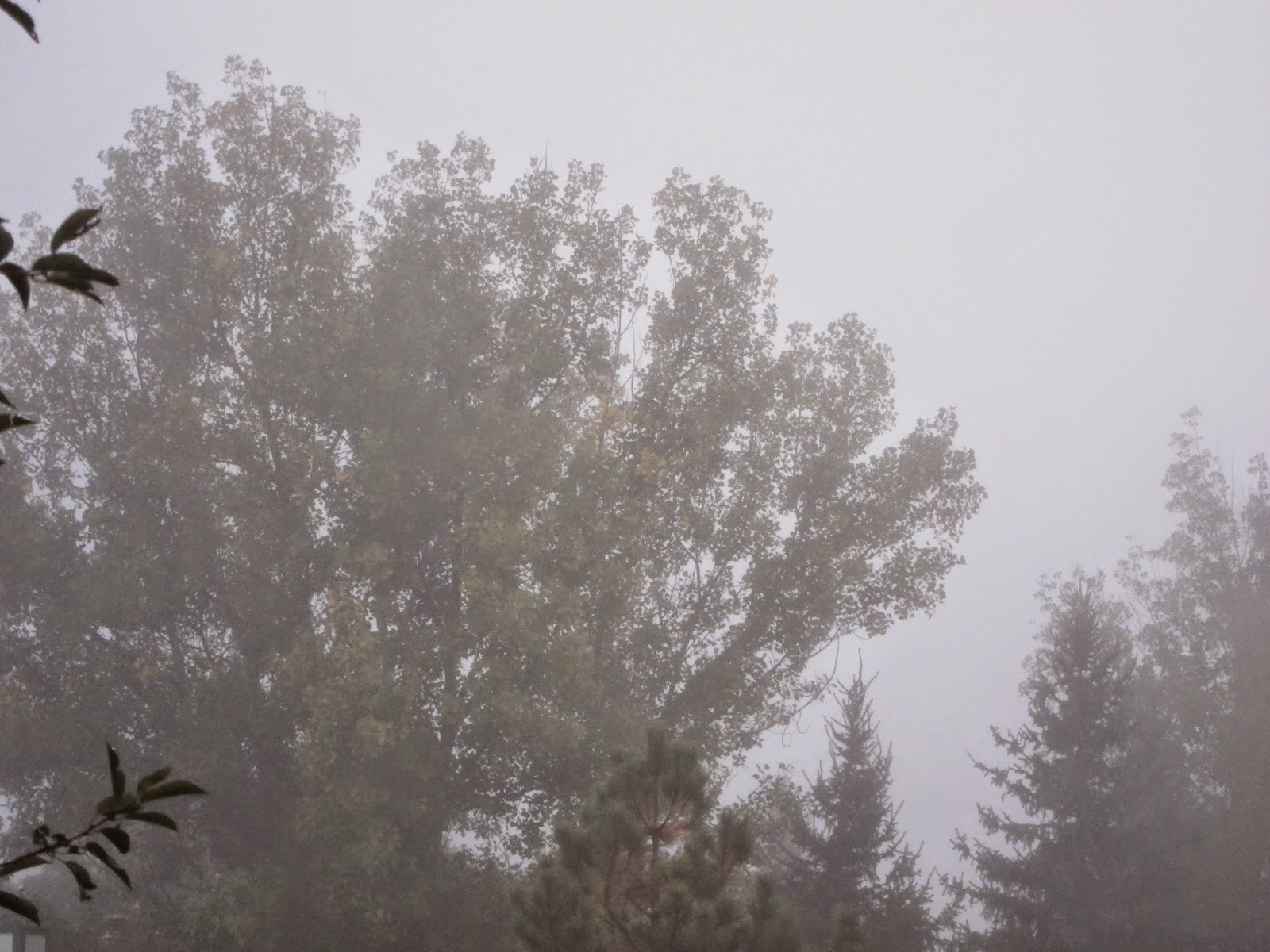
One of my most popular posts last year was “Misty Morning Hop,” which was nothing more than a collection of photos taken in my backyard on a foggy October morning. It captured a mood, though, and I was pleased others were able to enjoy that fine, holy quiet with me.

As it happens, I’m up early on a Saturday morning, and I realize I better grab the camera, because, as with the last time, I’m just one day ahead of a storm that will strip these just-turned leaves.


Not all of the trees have changed yet, but my favorite aspens over in my neighbors’ backyard will go naked nearly one month earlier than usual.


In the above photo, you can see how the fog is rapidly burning off. It was gone altogether before 9 a.m.

The Russian sage bloomed nice and pretty this year.


I felt honored to have this last look. Let it be known for the record that the early post-dawn hours of 11 October 2014 were solemnly beautiful. You had to be there.

Thursday, October 09, 2014

Needs More Clown: Watching Stephen King's IT on a Saturday Night

Well, if clowns are everything you were
ever afraid of, you’re still coming up short.
I wasn’t getting anything done at the keyboard anyway, so I made good on a threat I’d made to myself last spring to watch the 1990 made-for-television adaptation of Stephen King’s IT.

I bought the DVD and put it under the tree as a gag gift for Christmas four years ago. My children, who were five years removed from having seen it with me in another age and another state, actually backed away at the sight of Pennywise the Dancing Clown’s face on the cover of the DVD case. In all these years, we’ve never watched it, although I did learn my son had taken it with him to a sleepover once. “They didn’t appreciate it,” was all he had to say about it.

Tim Curry, on top of being the Sweet Transvestite from Transsexual, Transylvania, has ruined clowns for generations of children with this movie. Watching it again last night, I realized he really didn’t have a lot to do. And when he did have something to do, he could have done a lot more.

I can only imagine what people who had not read the original novel made of this. If you didn’t know the Lovecraftian backstory, the antagonist appears to be an evil, child-eating force that manifests as a clown before attacking. Not that he always eats them. In one case, we hear of a body being found that was “severely mutilated.” The modus operandi is entice-terrorize-kill. 

The first kill in the film is cleverly done in broad daylight, just before a storm. We first see Pennywise in and out of the blowing sheets on a clothesline. But does the girl go to see the strange clown among the sheets (who reveals his evil face at one point) or does the clown grab her? All we know is this happens in broad daylight, and the girl disappears along with the clown.
As soon as I saw this face I’d be inside that house so fast you’d think I’d teleported.


So what’s so special about the “Lucky Seven” or “Loser’s Club” kids that they don’t get killed when Pennywise shows up to terrorize them? The notion of these ‘tween and early-teen children getting together is borne of one character having his brother killed, along a public street (albeit empty of cars and pedestrians) in broad daylight. The entity we call IT (when IT’s not Pennywise) manifests itself in a talking photograph and a bleeding book to this same brother. His parents take the book, and seem not to notice the blood everywhere. Later, we learn that the citizens of Derry either don’t see these gory manifestations, or choose not to see them. These manifestations torment the children—six boys, and one semi-magic girl—and find them wherever they are. Yet, despite many encounters, in a school shower, a home bathroom, a Chinese restaurant, the school basement, etc., IT/Pennywise does not kill them outright as he does other children.

Note my slash. The entity that kills and eats children is not always a clown. Sometimes he appears as a big, moving, malignant ball of blinding light that can levitate its victims to their deaths. In the town library he’s a poltergeist blowing out the glass in the doors and sending books flying. We learn from the token black kid that every 30 years something awful happens in Derry, and what our hero kids are witnessing happens to be, well, IT.
Promises, promises.


Except we learn IT didn’t always terrorize before he killed. Also, he didn’t always single out children, despite describing himself as, “I am eternal. I eat children.” To cap off one 30-year period, the town was somehow enticed to a picnic in a meadow next to a metal works shop that exploded, killing adults and children alike. In another year, there was a big fire. (We see an old drawing, supposedly from the period, of Pennywise holding the match that started it.) Again, adults and children. Then there was that time in colonial days when over 200 settlers—say it with me—adults and children alike, disappeared without a trace, without so much as a “Crotoan” carved into a tree to mark their passing.

This major inconsistency threatens to obscure the biggest inconsistency of all, though: that this is a very, very  powerful entity, capable of taking on hundreds of humans at once, and it doesn’t care if it does its business by dark of night or by the light of the sun, because whatcha gonna do, puny mortal? So I ask again: how do seven children—children the entity is able to isolate and visit individually—manage not to get killed?

Incidentally, whatever power the Lucky Seven’s number had is diminished when one of the children, since grown, commits suicide rather than face IT/Pennywise again. This was something that could have been used as a pinch/plot point, but is essentially thrown away.

Reading the original novel won’t help on these points. Although, in a passage as reminiscent of James Michener as it was H.P. Lovecraft, we learn the entity crashed in from outer space during the time of the dinosaurs, and that little piece of real estate over the crash site, which would eventually become a town, despite all (including having the first settlement vanish entirely), was just rotten from then on.

[SPOILER ALERT] Reading the novel barely prepares you for the children encountering Pennywise one last time as a cheap projection on the wall before finding an impossibly tiny door to that leads to...the lair of a giant spider. Which has to be struck in its glowing underbelly with a wad of silver, then beaten with fists before having its heart torn out. Somehow, the spray from an asthma inhaler, which worked 30 years ago, doesn’t work so well when IT is in spider form.

The original novel is one of those Stephen King works you can effectively rip down the middle, and keep the first half as a really good book. Although in this case, we still had a very disturbing scene with the Loser’s Club (as they were exclusively known in the book), to wit: in order to cement the Mystic Bond between all the children, the girl of the group lies down for a mystic gang-bang from the boys. There was an image of birds gathering on a wire, then leaving the wire. There was nothing prurient meant by this, as near as I could tell (not that I was looking for it), but it was hard to look at these kids and not think about that part in the book:
NO.


So, no, don’t read the book. I love Stephen King, don’t get me wrong. He’s the only writer alive in America who knows how to write about what it’s like for normal, working people to actually have to live here. When he tries getting mystical, though, as he did bringing God into the post-apocalypse of The Stand, or riffing on Ancient Evils and where they come from in IT, he trips all over himself. 

The only reason for this nearly three-hour movie to exist is for the 15 minutes Tim Curry appears as Pennywise the Dancing Clown. It would have been gruesome good fun to really see him dance. I was at least hoping for some of that same frisson that frightened my then-small children ten years ago when we saw it on DVD for the first time. But that was then, and this is now. 

You know how the old tag line used to go, “DON’T WATCH THIS ALONE”? In this case, not having people squealing and screaming to either side of me drew my attention to everything that was wrong about the movie.

Wednesday, October 01, 2014

Rockin’ Roy’s Halloween Jukebox: Patti Smith, “Dancing Barefoot”

From Wave, 1979. 

The ominous E-minor/D/E-minor/A chords chugging behind Patti Smith’s sung melody in this dark love song blow through the speakers like a chill breeze on a warm Indian Summer’s day. Listen towards the end of the song as the keyboard wails and Patti Smith outdoes Jim Morrison’s spoken-word act by reciting a poem that actually makes sense:


Happy October. The month we've all been waiting for is here.