Tuesday, July 23, 2013

Fun with Old Zombie Fiction Tropes 2: The Firearms Expert

You know the story. The Mystery Virus comes out of nowhere and takes down a lot of people. Those people die and return as flesh-eating ghouls. Law and order collapses beneath their sheer numbers. Our hero finds himself separated from his family and spends the rest of the narrative fighting through mobs of deadly-ravenous former humans and flaky and/or devious survivors to get to his people.

With a few tweaks, that’s the basic plot to Bleeding Kansas. I did not presume to reinvent the wheel with my first novel. As a rock guitarist employs the simple pentatonic box scale to craft a lead solo, I ran my riffs off that basic zomfic template. 


Jimmy Page, Slash, and a host of other guitar slingers crafted memorable solos
using the above template. Of course, it helps tremendously
to be Jimmy Page or Slash to make it really sing out. 


Sometimes I wonder how many of these elements readers of zombie fiction expect in their stories. True, we can (and often do) omit the cause of the zombie apocalypse. We don’t need the whole Quest to Find My Loved Ones angle, either.

But it seems a given, in at least 99 out of every 100 zombie apocalypse books you’ll pick up, that you will encounter Sam Shootist and his encyclopedic knowledge of firearms from across the world. He knows the calibers of slugs they take, the general availability of said slugs, their range, their “stopping power,” etc. As zombie fiction tropes go, the Firearms Expert dominates. 

My own hands-on experience with firearms is extremely limited. I did not grow up in the country, so I never owned a plinker with which to shoot gophers and foxes and Mountain Dew cans. My military experience is limited to having married a Navy hospital corps/aviation med tech and drinking beer with Marines. 

I’ve met a few “gun people,” though, and from them I have learned the following:

1. Firearms are a serious investment of time and money. You have to clean your weapon lest the oil and dust turn your projectile-firing device into a hand grenade that blows up in your face. You have to take the gun out and fire it periodically to ensure it works properly. 

You’ll also need considerable time on the target range to ensure you can actually hit what you’re aiming at. “Point and shoot” works only with cameras. Cameras don’t jerk backwards with explosive recoil when you push the button.

But in case you missed it in that first sentence, here’s what really kills it for my broke, unemployable self:


2. Firearms and their ammunition, the cleaning materials, the time on the shooting range, the locks, the gun safe, etc., are a serious investment of money.

 So I’m not trying to be cute or in any way subversive/snarky/smart-assed when I make Derek Grace a relative “noob” when it comes to weapons in Bleeding Kansas  He’s not a man of means; he’s in the city for a fluke second interview and counting on the job to save his family from imminent homelessness. Fortunately, he’s locked up in a luxury hotel with a man named Tanner who gets a police-issue Glock based on his Colorado-issue concealed-carry permit and social engineering skills. Grace tries to bullshit his way into getting a pistol of his own but the cop has already been basking in the warm glow of Tanner’s smooth talk, and as Grace doesn’t have a permit, he loses out. 

The cop leaves to patrol his assigned blocks. We begin this excerpt with Grace asking Tanner what he does for a living, and continue with Grace’s basic education in firearms maintenance:

“So what are you doing out of Colorado?”

“I’m a security consultant. I give presentations to company boards about doing business in depressed markets. I advise them how to brand themselves so they don’t appear part of the problem, how employees should and should not talk about what they do, and so on.”

“Then I guess you’re all we need. I don’t have a gun.”

“I’ve got to sleep sometime. You can use the one they issued me.”

“I’m going to need some training.”

“I thought you told Officer—oh! Okay! Well, we’ve got plenty of time between now and when the burials start. Probably ought to clean this thing first, anyway. Good time to get you acquainted with the basics.”

Which we do. I’ve always meant to get a gun, but the general commitment involved with owning one put me off. You don’t just buy one of these things, load it and leave it in the nightstand drawer, hoping you’ll never use it. For my part, that’s just it: I knew I’d use it. Especially throughout these last four years when my general mood has been swinging somewhere between animal rage and oh-God-why-bother despair.

I go over and over taking apart the piece, reassembling the parts. Meanwhile, Tanner talks about himself, his five-star wonderful family living the Good Ol’ American Dream. To people like him the Great Recession is an attitude problem. Everything is onwards and upwards, the good getting better all the time.

As much as his prattling annoys me I’m grateful he’s not asking me any questions about my own family. Claire is dead. That’s my grief and mine alone. She couldn’t even kiss me goodbye because we couldn’t afford it. Couldn’t afford it. Seriously.

Well, honey, I didn’t get sick. Now what? Just think, poor Giselle has to bury her mother like icky poor people do in their icky poor countries. How could we be so selfish, thinking only of ourselves!

There are so many things I love about the above exchange, the first one being the notion of a “security consultant.” I’ve actually met people in Colorado Springs who make a good living in what I call the Bullshit Industrial Complex, doing nothing more than giving PowerPoint presentations to various companies. They use the generic “ex-military officer” line to give them the appearance of experience and knowledge. They’ll be sure to let you know if they’ve done time in Iraq or Afghanistan—it’s Serious Warrior Bonus Points, and a factor in their speaking fee—but as a non-flying officer, you can be sure his worst day in either locale was when the air conditioning broke.

It’s likely Derek Grace has met such people, especially at job networking events where these guys will come to perform their happy-talk Expert from Out of Town shtick. Grace is not interested in playing Neighborhood Watch with this fop in a white tennis outfit (yes, that’s what Tanner is wearing when we first meet him towards the end of Chapter 5). He wants this martial law in the city to get over with so he can get back on the road.  So the first thing Grace does is attempt escape by throwing a little raw meat at Tanner’s ego. 

Tanner needs an audience, though. Angie the Desk Girl isn’t much company, what with her getting sicker by the minute since Mr. Devereaux in 604 tore that chunk of flesh from her arm with his teeth. So he makes an offer to share gun duties. In a last-ditch effort to escape, Grace confesses he doesn’t have training. Tanner catches that Grace had lied to the police officer, and as one bullshitter catching out another, Tanner is impressed—and needing the company, offers to train Grace.

And while Derek Grace learns to disassemble, clean, and reassemble a common police-issue Glock 9mm, we learn the most important reason why he’s never kept a gun. It turns out to be the same reason that enables him to survive when the dead begin to fill the streets later in that same chapter.

The moral of this story is that any trope that comes up can be used to tell a little about the character and the world he lives in. Here, I took my own ignorance of firearms and turned it into a learning experience in more ways than one. Grace learns how to disassemble and clean a common Glock 9mm and we get an idea of how Grace is going to come into conflict with his new partner.

Derek Grace goes into the zombie apocalypse with a steeper learning curve than most. With a little tweaking of the Firearms Expert trope I add a world of depth and texture to what might have been a more ordinary zombie story.


BLEEDING KANSAS Copyright © 2013, 2014, 2017 by Lawrence Roy Aiken

Sunday, July 21, 2013

From Colorado to South Carolina and Back, Part 2

It looks as if these photo essays might go so far as a Part 3 or Part 4 if I’m to include all of the better shots my daughter took along the journey. If nothing else, though, I have to include these. These photos from the road to I-70 out of Colorado take us through the setting for Act One of Grace Among the Dead, the second book in The Saga of the Dead Silencer following Bleeding Kansas


This is what Monday morning looks like outside of Falcon, CO,
the last of the railroad watering towns outside of Colorado Springs.
These towns were meant to supply the trains with water until
they got to the retired Col. Palmer’s little health-resort scam in the
foothills beneath Pikes Peak.
Most people think of mountains when they think of Colorado but the eastern third of the state is rolling plains and ranch country. After a while you don’t even see the mountains. It’s a lonely, desolate country with a beauty you have to be a bit lonely and desolate yourself to appreciate. 

Like the mountains, though, the play of light will reveal surprising details and moods you never thought to see. The photos here were taken on a gray, unsettled July morning, and the country reflects the mood of the sky. We returned in bright sunshine, and these same empty landscapes sulking beneath heavy skies were exuberant with promises of space and freedom. 
I imagine dead former residents collecting against this cattle
fence and eventually making themselves fall over it should
they sight living meat on the other side.

The photos in this post were taken on our ride east-northeast along US 24 towards the I-70 interchange in Limon. It takes two and a half hours to get out of Colorado into Kansas. A good half of this time is spent on US 24, passing through the vast, empty ranch country and the old railroad watering towns along the way. 

Fun facts: each town is precisely ten miles apart, as that was the optimal distance old steam locomotives could travel until they needed water for their boilers. Also, because of railroad or post office rules regarding signage for the towns, the town names could be no more than six letters each. Hence, Falcon, Peyton, Calhan (named for a guy named Calahan), Ramah, and Limon. The only exception is Matheson—as it’s just outside of Limon, it’s outside the every-ten-mile rule as well.

They could be lurking at the feed store.
All of these towns are potential speed traps but perhaps the most notorious one is Calhan, which, given its relative size and density of population, can’t be blamed for wanting people to slow down through it. My daughter took a few pictures but none of them fit the general theme here. They’re not all that great on their own, either. 

All you see here is where I’d rather be. That is, if I can’t get back to the Dark Corner of South Carolina right away. This is certainly a good place to be as the zombie apocalypse becomes the New Normal, but you have to be careful—it doesn’t take long for the local undead population to gang up into an unmanageable number, especially if they’ve all already set out to find you, following the noise of your vehicle or your gun. Remember, the walking dead don’t have to stop and rest. They’ve got all day and all night to come for you.


“They’re coming to get you, Barbara!” Eventually. Give ‘em time. It’s a mess o’ country out here.

I imagine these fences going down a lot more easily, especially given the relative density of population.

My second favorite photo of the bunch. Such beautiful emptiness! Of course, you have to be a hardcore misanthropist like myself to truly appreciate this scene, let alone the kind of zombie fiction I write.

I imagine this is what it looked like while Derek Grace was holed up at Hidden Farm, except he had a better screen of trees growing up along the drainage and irrigation ditches outside the farmhouse.

This is exactly what the dirt road and the house look like to me in Chapter 5 of GRACE AMONG THE DEAD.

My favorite photo of the bunch. I love how the strata angles over the rise and behind the water tower. I’m reminded of Joe Mugnaini’s cover for Ray Bradbury’s 1973 paperback edition of The October Country.

Saturday, July 20, 2013

From Colorado to South Carolina and Back, Part 1

It’s a bummer deal, and all I have to work with right now. It takes two days to drive out to upstate South Carolina from the lower middle of Colorado. Two days of twelve-hour driving each day. Upon arriving at my destination I’ll need one more day to recover. Okay. Fine. Done.

Then I scramble about trying to see the Most Important People and try not to feel too resentful for having to go-go-go when I was hoping to get a little more rest on what I was hoping would be a nice vacation. I spend the Fourth of July with my irascible, working-poor brother in the crumbling, roach-infested double-wide trailer he rents in Pontiac, SC, and wince for his poverty, knowing I’m not very far behind him if I can’t make things happen with my Hail Mary pass of a book. In a few short years he’ll be too old to work. I’m already unemployable.

My brother and I stay up talking until five in the morning. I sleep three hours on a cramped, filthy couch before getting my children up and pulling out before anyone else wakes up. I know he’s pissed. But I could feel myself getting dumber, feel the gross tonnage of hopelessness pressing down with every minute spent in that environment. I can’t afford being dumb and feeling hopeless. I don’t want to get the least little bit used to it. 

After one week in South Carolina—one week!—I have to leave, feeling guilty for all the people I missed, realizing this is all so stupid. My people, everyone who matters to me, are only a few hours away from base camp in Marietta, South Carolina. Why am I living in Colorado? What on earth drove my wife and I to chain ourselves to a home mortgage 1,500 miles and a two-day drive away?


Woods so thick, Bigfoot couldn’t squeeze through.
Ah, base camp. I could easily spend the entire vacation where we were staying and tell no one I was there. My friend-who-is-like-a-brother to me bought eight acres of land on a tall ridge in the thick woods ten miles northwest of Traveler’s Rest, SC, a.k.a., “the Dark Corner,” where the old-time moonshiners used to operate. I’m talking thick woods—with the heat and humidity and machete-ready foliage. Think Vietnam with oaks and pines, minus the little people in black pajamas trying to kill you.

He bought those acres and built a house to his specs, complete with a bedroom and full bath set aside for visitors such as myself. He even had a deck built atop a two-story “tower” that encompasses a view of Caesar’s Head and various other summits in South and North Carolina. He’s so close to the border he named his estate the Keep on the Borderlands, with a nod to the second Dungeons and Dragons module from 1978. Which I suppose might get him labeled an “eldergeek,” except geeks don’t buy land and have houses built to spec.


Looking west from atop the Tower. James Robert Smith would
know what that peak is on the left. All I know is that it’s green
and quiet up here, and that I don’t want to leave.
The Internet out here is limited to minutes on his phone service, so no time is wasted on Facebook and Gmail and whatever else I spend too much time on in my basement office in Colorado. I make quick status posts and bail, the way it should be. I spend an entire Saturday enjoying old movies on TCM with my friend-who-is-like-a-brother, and resolve to watch at least one classic or semi-classic movie on Saturdays to come—it turns out I’ve spent more time reading about movies on the Internet than actually watching them.


Still looking west, but a little more north this time.
The following Sunday I enjoy a few hours at the tail-end of a pig-pickin’ and pool party in West Columbia, South Carolina, with a side of my family I haven’t seen since my step-father’s funeral in 2008. Still, I miss seeing James Robert Smith in Charlotte. My sister in the Outer Banks is disappointed we don’t stop by for a few days at the beach. I can do no more, though. The van is nearly ten years old, with a cracked engine mount, and everything is going on the credit card. I’ve still got the wife back home in Colorado, and one week to me is two weeks to her, especially as we spend a total of four days on the road, just driving.

I piss away the following Monday doing nothing more than noodling on my manuscript for Grace Among the Dead and mentally preparing myself for the voyage back to the Centennial State. Tuesday I take my friend’s wife to a doctor’s appointment in downtown Greenville, then drive the van to the Walmart in Traveler’s Rest for an oil change and check-up.

It is with heavy heart that my children and I depart early Wednesday morning. Last year when we did this I was fired up, full of ideas of what I wanted to do when I got back to Colorado. Now—despite having published a book, despite having sold the German-language rights—I’m boiling over with worry. What if I never make enough money to pay down my debt? What if we never get out of Colorado? Will I even be able to afford to do this next year?  


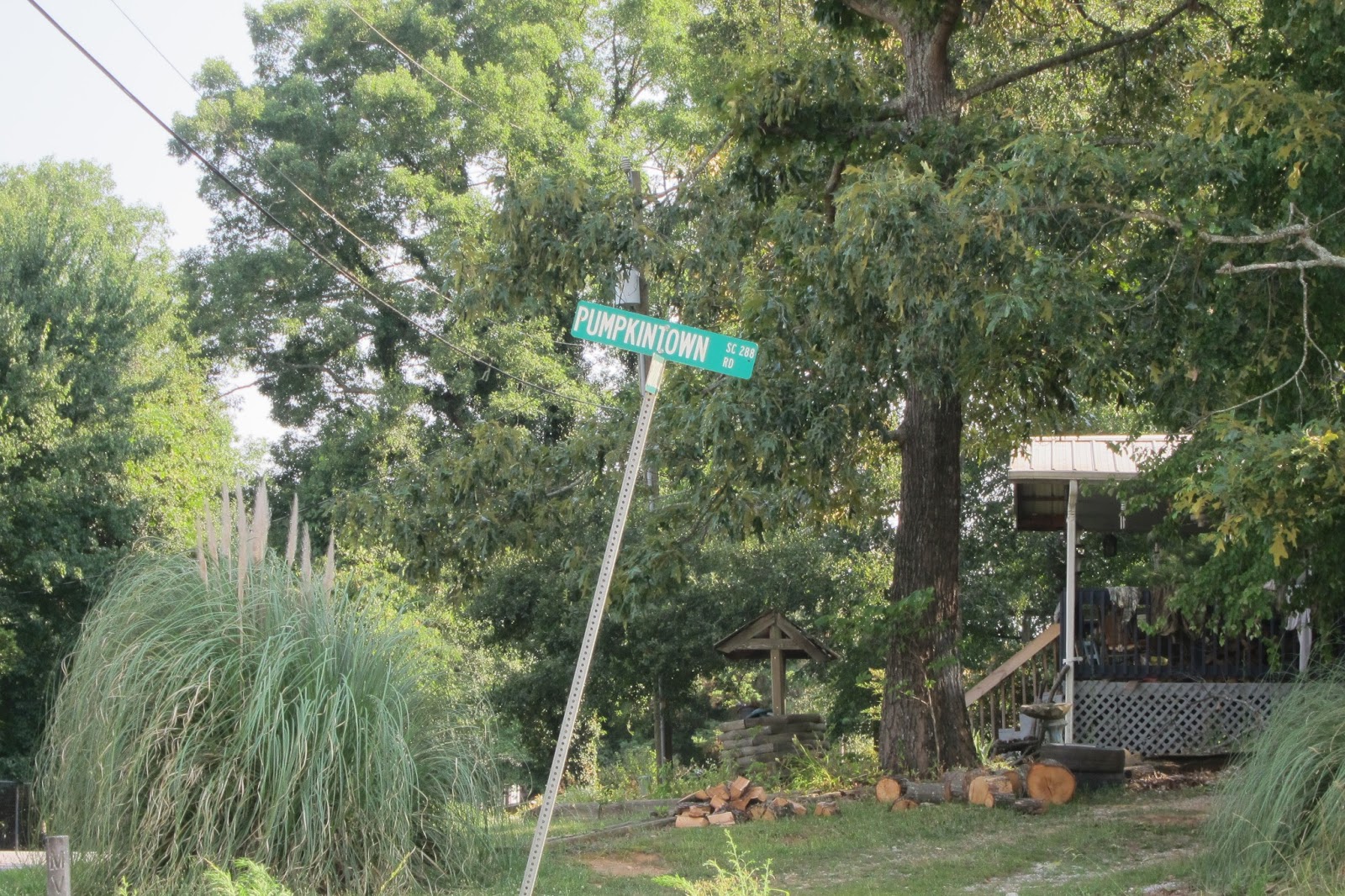
Take me home, Pumpkintown Road!


I keep telling myself this is all up to me. I’m going to have to make my own luck. Keep writing, keep promoting the book that is already out there. My son still has two years of high school left; that’s just enough time to get our metaphysical ducks in a row and get back to where we once belonged. 

It will help tremendously if I can bust out of this post-travel funk. It’s been over a week since we got back and I still feel like I’m in recovery. “And so we beat on, boats against the current....” That’s pretty much the way it feels right now. Goddamn, I’m tired.

Related: Cross-Continental Burn-Out Blues,
From Colorado to South Carolina and Back, Part 2,
From Colorado to South Carolina and Back, Part 3,
From Colorado to South Carolina and Back, Part 4.

Thursday, July 18, 2013

Cover to the German Language Edition of BLEEDING KANSAS

The good people at Severed Press sent this to me last night. The German publisher is a separate entity so the translation and the promo art are out of our hands.

Still, I have to say I like this, bib overalls and all. Even if Derek Grace’s preferred weapon is a panga (one million dead and amputee Rwandans can’t be wrong), the gun-in-each-fist and bustin’-out-of-the-frame design accurately reflects the spirit of two-fisted adventure in which I wrote the book.

Despite my Anglo surname my ancestral background is largely German, so I’m pleased as punch I’ve got this much of a psychic toe back in der Vaterland. It would be a dream come true if I got popular enough to have some zombie/horror club there invite me over for a convention. 

But that’s just a dream. In reality Bleeding Kansas is one of many books the Australian-based Severed Press has sold for the German translation rights. Which means there is a market for zombie fiction there, and I’m one of many competing for market love. I get why zombie fiction is big in the Anglosphere—but do the same reasons apply to Germany? If I might hazard a guess, I’d say, “Sure! Everything stinks everywhere. Just like us, they’d prefer a zombie apocalypse to the more banal apocalypse we’re suffering through now” but that’s presumptuous. I’d really love to have some natives explain this to me.

In the meantime I can only hope the translators knew what to do with the American Vulgate in which I wrote the book, and that my German readers connect with the story. I need to get off the damn Internet and get back to work on the sequel.

For less than the price of a beer! And you
will need that beer to settle your nerves
after all the pulse-pounding action you'll
read here.
Of course, if you read American Vulgate, like zombies, and don’t mind a cover created and designed by the author (with an assist from his Photoshop-literate offspring), we’ll always have Amazon. I’m especially partial to the paperback edition as it makes me feel like a “real” writer, but the Kindle version can be had for less than it costs to buy yourself a beer at your favorite happy hour bar. Then again, both versions have great “price points” (as the better-dressed hustlers call it now) so why give yourself a headache over the decision? Buy both! This unemployable middle-aged crank working from his Colorado basement will ruv you rong time! His family will also be grateful, if only to keep that horrible snarling thing in the basement where it belongs.

I have links to excerpts from Bleeding Kansas below. If these don't make you want to buy the book then maybe you're more of an Eat, Pray, Love fan. No hard feelings:


Just enough to whet your appetite for more undead flesh.
Most of you have read this already. The full chapter, of course, is even more of a scream.
I hate those damn teenagers. Always setting my stuff on fire!
Another excerpt, another street full of smoldering corpses. Move along!

Fun with Old Zombie Fiction Tropes 1: the Apocalypse Virus

You’d think “the mysterious virus” was there at the very beginning, but it was the return of a “Venus probe” that kicked off the original zombie outbreak in George Romero’s Night of the Living Dead in 1968.

Romero deliberately avoided explaining how the zombies came about in his subsequent movies. Meanwhile, the trope of “the ______ Virus” became the go-to explanation for what killed, then resurrected most of humanity. 

In Bleeding Kansas I imagine my bug as a living, flesh-eating bacterium using reanimated corpses as a living-flesh delivery system, but that’s a small distinction I don’t even bother going into in the book; it’s just what I, as the writer, know. Yes, bacteria are living organisms, viruses are not, but no one cares about that. It’s what that makes people sick, kills them, then brings them back to eat the living. It’s all anyone needs to know.

It’s a trope that is as useful as it is convenient. It answers the question people often ask regarding how how stupid, slow-moving zombies could overwhelm civilization so quickly. Consider: if everyone who has a job is already doing the jobs of three people, and one in three of those people get sick, the infrastructure is going down. Especially when those people who aren’t sick, who have no loyalty to jobs that would dump them in a heartbeat, stay home to take care of their sick.


Everything will go on full automatic until it all grinds to a halt. Which it will, shortly after the dead rise to attack the people taking care of them, and turn them. In short order the living dead become the apex predator of the New Weird Order based on numbers alone. 

In Bleeding Kansas I use the “Mayday Malaise” as a tool to increase the anxiety of an already anxious protagonist. His wife is sick, the cab driver who drove him to the airport is sick, but it’s not the end of the world for him in the sense we know it will be. For Derek Grace, the pandemic threatens to take away his last, best chance for lifting his family out of imminent destitution. Meanwhile, it’s as if the world is mocking his desperation. As this passage opens, Derek Grace has just left the cab and entered the airport concourse:


I’d like to think that’s the end of it but I’m running a gauntlet of sneezing, coughing people all the way to the fat lady at the ticket counter. She got a red Hitler mustache of raw skin under her nose from wiping at it with her third wad of tissue.

I wish I had some tongs or latex gloves with which to take my boarding pass. For God’s sake, I can’t afford to get sick, not for the best chance for gainful employment I’ve had in years! It’s probably a matter of time, though. Turning away from the counter every other person I see is suffering from some degree of the “Mayday Malaise.”

That’s how the logo reads behind cable news queen Stefani Dunham on TVs all over the airport. “Now this is a different kind of cold bug,” she says. “Aside from the fact that one out of three people come down with it, you can actually sort of function through it! Of course, some are saying it’s because Americans with jobs are afraid to miss work for any reason, given the economic situation.” Our head cheerleader-cum-broadcast journalist makes a face to let us know what she thinks of some people.

“Whatever the case, doctors say it’s an aerosol virus, which means it’s all up in your air!” The shot cuts to a gray-haired eminence mumbling authoritatively in a plush office. Back to Stefani: “And we’re not immune here!” She coughs theatrically into a handkerchief. “All this and a runny nose! A big shout-out to my make-up people here in the News Center for keeping me presentable! Hey, we carry on, what can you do?”

With my Irish luck, that’s the strain I won’t be getting. Claire struggled to make it to the bathroom and that poor dumb cabbie I rode in with was barely functional. 

If you’ve even suffered through a cable morning “news” show in this benighted empire-in-decline that is the USA, you’ll understand that, yes, the anchorlady is really that bad. I don’t care which channel you watch.


That aside, my hero, Derek Grace, eventually has to face that he’s abandoned his wife, who was indeed sick unto death, and now he’s 600 miles from his surviving children because he couldn’t miss an interview that wasn’t going to happen anyway. It’s the sort of thing that leaves a mark on one’s character, embittering him, hardening him—and making him perfectly suited for the World That Is To Be, in which Things Unnatural roam the land, where only the most ruthless of the survivors stand a chance.


If you  can’t feed ‘em, don’t breed ‘em! That’s all I’m sayin’.


Bleeding Kansas Copyright © 2013, 2017 by Lawrence Roy Aiken
Monday, July 15, 2013

Curse of the Dog People

This actually has something to do with zombies. Honest!


I’ve nothing against dogs. They’re fine companions. I simply prefer the quieter and relatively low-maintenance company of cats. A good, well-mannered dog is a treasure, though. No arguments there.

On the other hand, most “dog people” (please note the boldfaced qualifier), shouldn’t own a goldfish, let alone a canine.

A case in point: my daughter’s boyfriend’s family took in another family’s cat for a temporary stay. The cat’s owners had recently adopted a couple of dogs and wanted them to “settle in” before getting them used to a cat. The understanding—repeated urgently and often as the transaction was negotiated—was that the arrangement was temporary.

After a month, the family that took the cat in approached the cat’s original family about taking their cat back. The original owners acted as if the original arrangement had never happened. When confronted, they said, “Well, do what you want with the cat, okay? We like our dogs and we’re not taking him back.”

The cat in question is a very loving, attractive, tailless Manx. This cat had lived in what it presumed to be its Forever Home for six years. Six years. And using deception, justified by that special strain of smug righteousness (“we’re dog people!”) that begs to be punched in the face, they kicked that cat to the curb.

By now, I expect apologists for this sort of behavior to be spluttering, “Well, at least they didn’t just abandon it outright. They found a family for it!”

Yes, they found a family for the cat. By lying to them. And they didn’t care if that family took that cat to the animal shelter to be put down, etc. They still abandoned the cat. They didn’t care if they broke trust or lost friends to do it—but that’s better?

It’s no better than how a friend of mine in South Carolina ended up with his cat, who showed up on his back porch in the freezing rain. That cat used to live up the road with another family. When my friend confronted that family, he learned they’d recently gotten a dog, so out went the cat.

“Cats are hunters. He’d learn to live in the woods,” said this dog person. No. It doesn’t work that way, either. Especially when the cat has grown up with your family. The cat would have starved and died in loneliness and misery. But he found another family to take him in, so what you did is okay, right? 

That’s the mean, middle-school fat-kid logic of dog people. These are the same blustering fools who wonder aloud what the world is coming to when they hear of some random bit of homicidal mischief on the news, who thunder about the lack of accountability and compassion among “some people.” 

The hell of it is, dog people aren’t even good for their own dogs. Lest you think this is a simple cats vs. dogs rant, I point out that a lot of dog people get dogs because, well, other people have dogs and—using the same “logic” that explains the proliferation of iPhones, iPads, and other assorted iCrap among people who who should know better—it seems right to have a dog. It’s what people do. So they get a dog. 

And then they tie it up in the backyard to go insane with loneliness and thirst, because they don’t want it inside. Or otherwise ignore it, don’t bother to train it, then beat it, or eventually abandon it altogether. (Dogs are social animals. The craziest, most neurotic dogs you’ll ever meet are those who get little or no attention from their owners.)

Or maybe they’re the bright-eyed, grinning imbecile I meet in the supermarket parking lot at least once a week who says, “I go everywhere with my dog!” As if leaving a helpless animal to suffer in the back of a hot truck flatbed (or worse, and more common) locked inside a car with the window barely cracked, if at all, is something to be proud of. It means they go everywhere with their dogs, so therefore they really like dogs, and can’t be held accountable for essentially torturing them. Besides, the dog lives, right? So, it’s not, like, cruelty, y’know?

Mind you, I know responsible dog owners. Great people. All two of them. Most dog people, though, are vile specimens of humanity who should be “put down,” and none too gently at that.

Sadly, we can only get away with that in fiction. Which brings us to Plug Time: if you really like dogs, and hate “dog people,” my good friend James Robert Smith has the zombie apocalypse for you. In Smith’s book The Living End, an abandoned border collie takes his vengeance upon the family—and, by extension, all of humanity—that left him alone to starve amid the ruins of civilization.

Honestly, how often do you you come across “a novel about zombies with dogs”? One in which the alpha dog is the hero? Check out the sample pages on Amazon and decide from there if you’re willing to proceed with something so deliciously different than the usual.


In paperback AND Kindle editions!

Cross-Continental Burn-Out Blues

Confessions of a Weary Deep Space Minivan Pilot


It’s official, which is to say, inescapable. I’m too old for this.

I used to enjoy driving cross-country. In the late 1980s I relished the road trips I took from South Carolina to New York and Florida and points in-between to hustle comic books with James Robert Smith at conventions. As a Navy spouse in the early 1990s I enjoyed driving from South Carolina to Alabama (my wife’s home state) to Great Lakes, Illinois. After a few months in Pensacola, Florida, I drove my first trip west to California, then back again to Alabama with a toddler daughter strapped into the backseat. Nothing burned the concept of adult responsibility into me more than having a tiny little someone in the backseat entirely dependent upon my disposition at the wheel.

Not that I ever did much in the way of hotdogging. I still smile when people give me grief for not driving much more than five miles an hour over the posted speed limit because I can boast of hundreds of thousands of road miles behind me without a single accident. Not so much as a fender-bender. I don’t screw around behind the wheel. I take great pride in arriving alive and unmolested. 

In the late 1990s, back from a mid-decade, three-year hitch in Japan—and with another child strapped into the backseat—my wife and I thought nothing of making the circuit from Beaufort, SC, to Greenville, SC, to Atlanta and Huntsville, Alabama, and back over the course of a 96-hour pass. Since that time I’ve driven from Anchorage to Silverdale, Washington; from Washington state to Hampton Roads, Virginia; from Virginia to Colorado. 

As I write I realize I’m leaving out my epic New York/Charlotte/New Orleans voyage of 1988, my drive to Fairbanks, Alaska, from Anchorage in 2003. The point is made, though. What was once a happy kick-in-the-pants is now an onerous chore. I’ve been home in Colorado for over 72 hours since returning from my last journey to South Carolina and I’m still getting over the drive. Times were all I needed was a good 12-hour nap. Now, I need several in a row.

Overall, though, the mission was worth it. Both my children got to see and appreciate family. I just can’t do this again any time soon.

Back to work, then.

Related: From Colorado to South Carolina and Back, Part 1,
From Colorado to South Carolina and Back, Part 2,
From Colorado to South Carolina and Back, Part 3,
From Colorado to South Carolina and Back, Part 4.

The road goes on forever and the party never ends.

###